Arushi Sharma Frank originates market structures that turn new technology into grid infrastructure at scale — and creates the investment thesis that brings institutional and venture capital into infrastructure solutions that grow the public moat. A STEM scholar, investor, and grid-policy architect, she works where technology, market design, capital, and public infrastructure meet: creating pathways for private innovation to produce both investable returns and stronger, more affordable systems for the people who depend on them.
She is a changemaker veteran of the American Gas Association and Electric Power Supply Association, former head of power plant grid rules compliance at Constellation, and former U.S. Energy Markets Policy lead for Tesla. Her institutional reach spans Washington and beyond, with affiliations including C3 Solutions, AELI Action, CSIS, Johns Hopkins SAIS, the University of Texas KBH Energy Center, IHS, and CIGRE. She also guest lectures at West Point, Harvard, Duke, and more — galvanizing STEM students to do more for their country.
Her story
Build the market, then build on it.
01Regulatory WinsAcross dozens of federal and state agencies.
02Systems MasteryElectrical, mechanical, software, hardware, and power systems.
03Coalitions & AdvocacyThink tanks, advocacy, trade associations, and coalitions.
04People & PotentialPeople, training, teaching, and identifying alpha in human beings.
05Company BuilderBuilding companies and building startups inside large companies.
06Language FluencyAcross students, engineers, operators, business people, investors, politicians, regulators, and lawyers.
07A Stronger AmericaAmerica, Americans, the human condition, conservation, and prosperity outcomes, including scholarship at IHS, CSIS, and C3.
Originate markets for batteries
Creates new market pathways for grid-scale batteries, microgrids, solar-plus-storage, and resilience programs.
Originate virtual power plants
Originates VPP programs and market frameworks that turn distributed batteries and customer assets into grid resources.
Train and teach AI-energy teams
Trains AI-energy teams to translate advanced technology into grid participation, market strategy, and scalable infrastructure programs.
Build entry and growth for Prosperous Infra
Builds the policy, market-rule, commercial, and regulatory pathways that allow prosperous infrastructure companies to enter markets and grow.
Arushi Sharma Frank
01
Company Enabler
Her venture studio at Luminary Strategies has enabled multiple AI and energy-infrastructure founders, including the award-winning teams at Base Power Company and Emerald AI. Through Prosperous Infrastructure, she is building a platform for companies working across the hard-tech and soft-tech layers of the AI and grid-resilience era, including Agentic Infrastructure, Powertown, and V-Wire. She creates the market, policy, regulatory, and investment conditions that allow new infrastructure companies to exist, raise capital, enter power markets, and scale.
02
Grid Infra Builder
Sharma Frank’s work has created gigawatt-scale pathways for batteries, distributed energy, resilient microgrids, and flexible AI load.
Texas · Tesla
At Tesla, she pioneered ERCOT policy and market-design frameworks for utility-scale battery participation, residential battery virtual power plants, and dual-use grid storage. Her early Texas work created the pathway for projects such as the 100 MW Gambit Energy Storage project and the wave of grid-scale batteries that followed it into ERCOT. Bloomberg chronicled Gambit as Tesla’s then-secret entry into the Texas power market.
She then originated Texas’s Aggregated Distributed Energy Resource pilot, establishing a globally replicable framework through which residential batteries and other customer-owned resources can participate in ERCOT markets as aggregated grid resources. Texas knows Sharma Frank as the technical advocate and activator of the ADER Task Force, and ERCOT records show her leading rule changes governing aggregated load participation across dozens of meetings and over two years of deep work enabling a new way to commercialize resilience for people.Source: Public Utility Commission of Texas
That work extended beyond Texas. Her advocacy actuated the framework that became Puerto Rico’s Customer Battery Energy Sharing program, which now coordinates tens of thousands of residential batteries as a grid resource. Public profiles of her work credit her advocacy as essential to the program’s launch; the program has since grown into one of the country’s largest behind-the-meter virtual power plants.
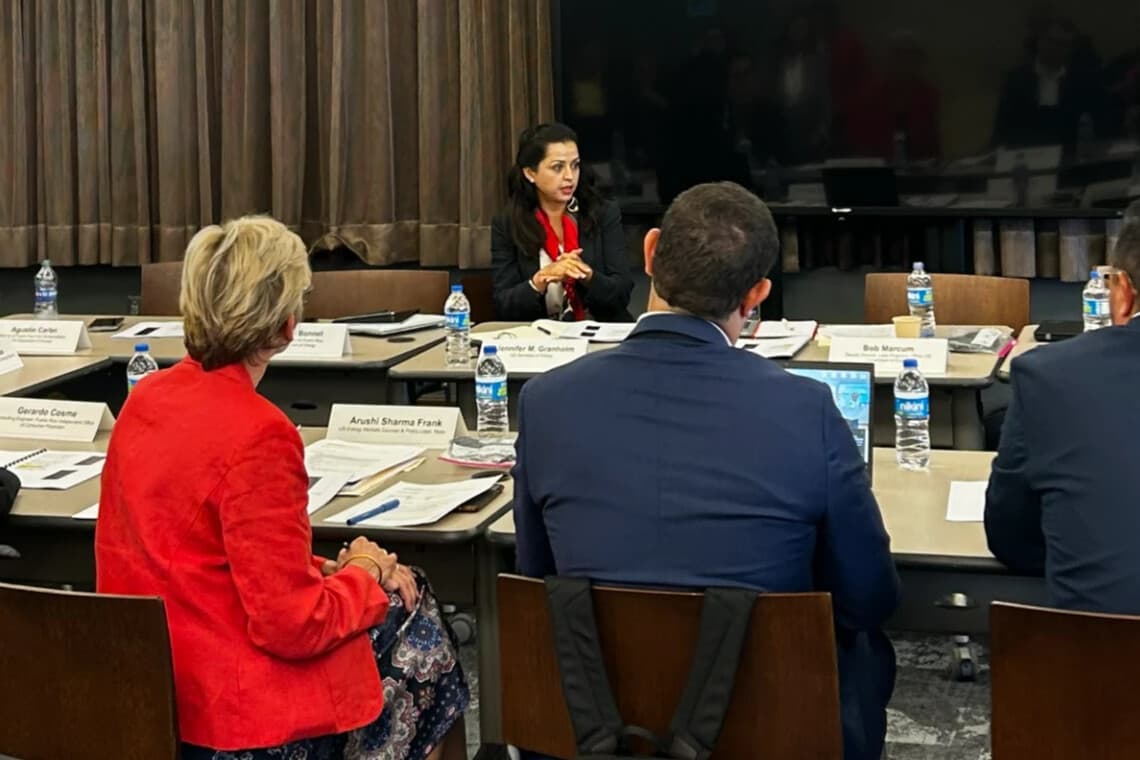
Arushi Sharma Frank in U.S. Energy Secretary Jennifer Granholm’s seat at the Puerto Rico DOE LPO Liftoff Roundtable, 2023. Secretary Granholm put her there to explain how she could activate thousands of batteries to support Puerto Rico’s grid overnight.
New Orleans
In New Orleans, Sharma Frank designed the citywide solar-and-battery resilience proposal now moving toward implementation. Canary Media reported that she assembled the thesis that convinced City Council to build this resilience solution for the City in 72 hours, drawing on the VPP models she had helped develop in Texas and Puerto Rico, and mobilized experts from 12 states to support the proceeding.Source: Canary Media
Most recently, she originated the policy architecture that became the foundation for ERCOT’s Provisional Controllable Load Resource approach to large AI and data-center loads, covered extensively by Heatmap. Luminary sponsored PGRR134, which proposed allowing dispatchable large loads to energize earlier when they could manage their consumption in response to grid constraints. ERCOT’s subsequent Batch Zero rules formalized a new large-load interconnection process in 2026.Source: ERCOT
Now, her firm is backing the next evolution of grid architecture: making it easier for loads to participate as grid assets, and enabling paired grid resources like batteries and small generators to show up on the grid, growing an ecosystem of reliability for all grid consumers.
03
Abundance Activator
The through-line across Sharma Frank’s work is a belief that infrastructure should do more than accommodate growth: it should create abundance around itself.
Her market designs make new technology valuable to the system around it — enabling batteries to earn money while supporting reliability, households to become compensated grid participants, communities to gain resilience assets, and data centers to secure faster access to power while taking responsibility for the constraints they impose on the grid.
That is the idea behind Prosperous Infrastructure: use market design, technology, and private capital to make infrastructure more investable and the public system stronger. The objective is not simply more infrastructure. It is infrastructure that expands markets, protects affordability, improves resilience, and leaves the people who depend on it better off.